
AI Generates 3D Assets in Seconds, But Here Is Why You Still Need a Real Engine.
AI Can Now Generate a 3D Character in Seconds — So Is It Time to Ditch Unity and Unreal? A tour of the new AI tools generating 3D models, motion, and full scenes — and an honest look at what they still can't do without a real engine behind them.
30 sec: to auto-rig an animation-ready character with today's leading AI tools
4: distinct jobs the AI game-dev stack now splits into: build, generate, code, design
2: engines still standing at the top of production pipelines: Unity and Unreal
1: From Prompt to Textured Mesh in Under a Minute:
The most visible shift in 3D production this year is text-to-3D and image-to-3D generation — tools that skip modeling entirely.
Platforms like Meshy, Rodin (from Hyper3D), Tripo, and 3D AI Studio take a text prompt or a reference image and return a textured 3D model in minutes, complete with PBR materials and export formats like FBX and GLB that drop straight into a game engine.
Meshy has built a reputation as an all-in-one generator, combining text-to-3D and image-to-3D with automatic remeshing and character auto-rigging that can prepare an animation-ready skeleton in well under a minute. Rodin takes a slower, more deliberate approach aimed at production use, prioritizing clean topology and proper UVs over raw generation speed.
For concept art, prop libraries, and rapid prototyping, this compresses what used to be hours of modeling work into a coffee break.
2: Motion Capture Without the Mocap Suit:
A second wave of AI tools is going after animation itself — specifically, turning ordinary video into usable character motion.
DeepMotion, Move AI, Cascadeur, and V2Fun's video-to-motion module all extract human movement from standard video footage and convert it into animation data that can be retargeted onto a rigged character, no motion-capture suit or studio required.
NVIDIA's Audio2Face and MetaHuman Animator push this further for facial performance, generating convincing lip-sync and expression directly from an audio track. For small teams and independent animators, this is the closest thing yet to a mocap stage in a laptop.
3: AI-Native Engines Are Starting to Appear:
A newer category skips the separate generate-then-import workflow altogether by building AI directly into the engine.
Browser-based engines like Nilo bundle generation, auto-rigging, animation, and natural-language scripting into a single environment with no desktop install. Summer Engine takes a different route, running an AI agent inside a Godot-compatible editor that can build and edit a live scene through natural language, while Unity Muse and Unreal's own AI assistants bring similar generative features directly into the established engines rather than replacing them.
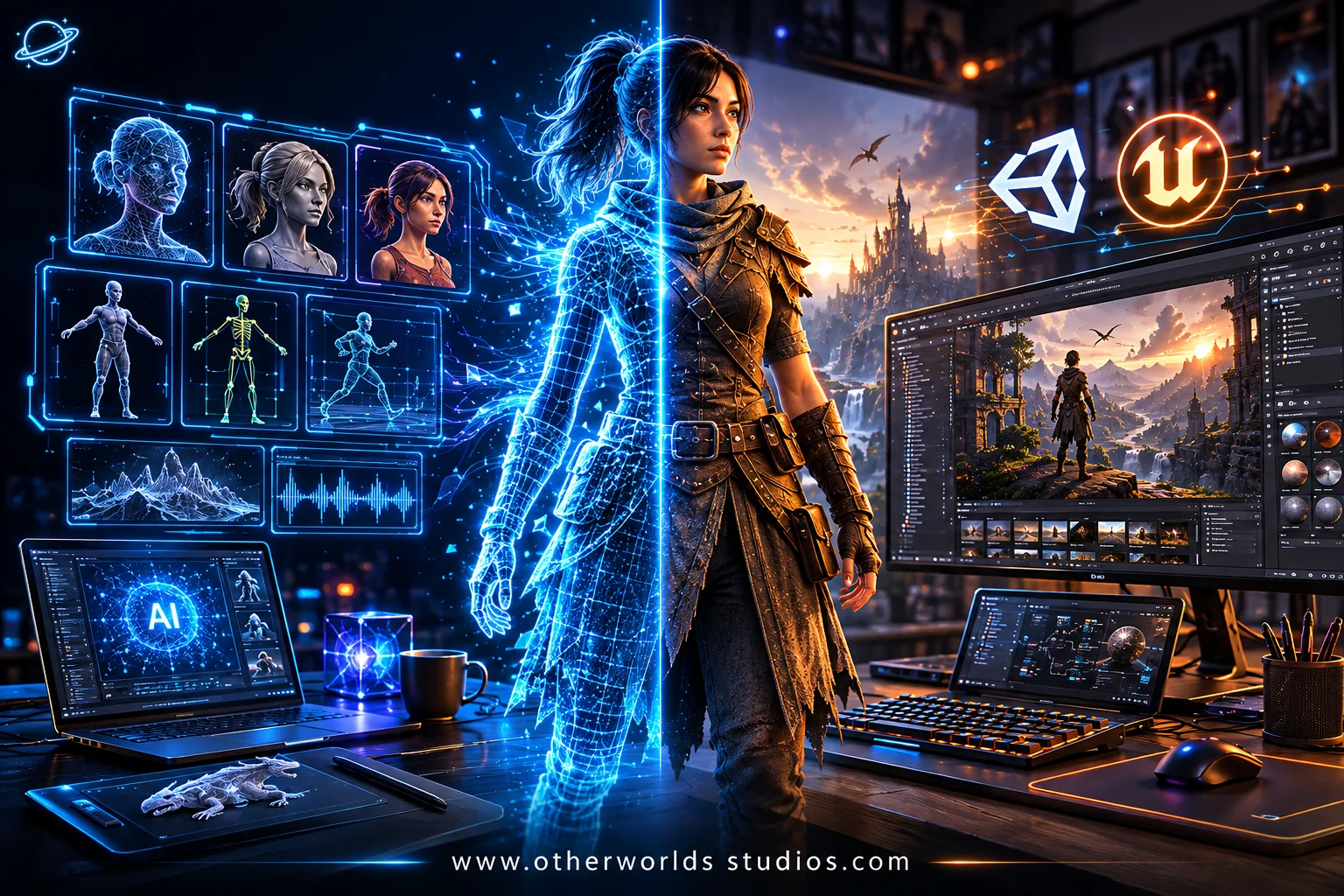
AI now generates the model in seconds — but shipping it still runs through Unity or Unreal. — Otherworlds Studios
4: Where Unity and Unreal Still Win:
Generation speed is not the same thing as production quality, and that gap is where traditional engines still earn their place.
A 2026 workflow study comparing a human-authored Blender pipeline against an AI-assisted one on the same stylized scene found the AI-assisted version came out with denser, less efficient geometry and fragmented UV maps — the kind of hidden technical debt that shows up later as performance problems or animation glitches. AI-generated meshes, especially anything meant to deform or animate, typically need a remeshing and cleanup pass before they are truly production-ready.
Unreal's Nanite and Lumen systems still set the bar for real-time visual fidelity on high-end hardware, and Unity remains the more practical choice for mobile and cross-platform reach. Both engines also offer the deep control over lighting, physics, and interactivity that a generative tool, by design, can't hand you out of the box.
The realistic picture for 2026 isn't AI replacing these engines — it's AI tools feeding faster raw material into pipelines that still end in Unity or Unreal for the final, polished result.
Speed From AI. Polish From Real Engine Craft.
At Otherworlds Studios, we run AI generation and traditional Unity and Unreal Engine pipelines side by side — using AI tools to rough out models, motion, and environments fast, then bringing them through the same clean topology, lighting, and rendering craft that has always separated a game or animated short that looks finished from one that just looks generated. Whichever stage your project is at, we can plug in.
Talk to Otherworlds Studios about your next project — reach out through otherworldsai.com.