
Inside WorldClaw: The Agentic AI Turning Text Prompts Into Explorable 3D Environments.
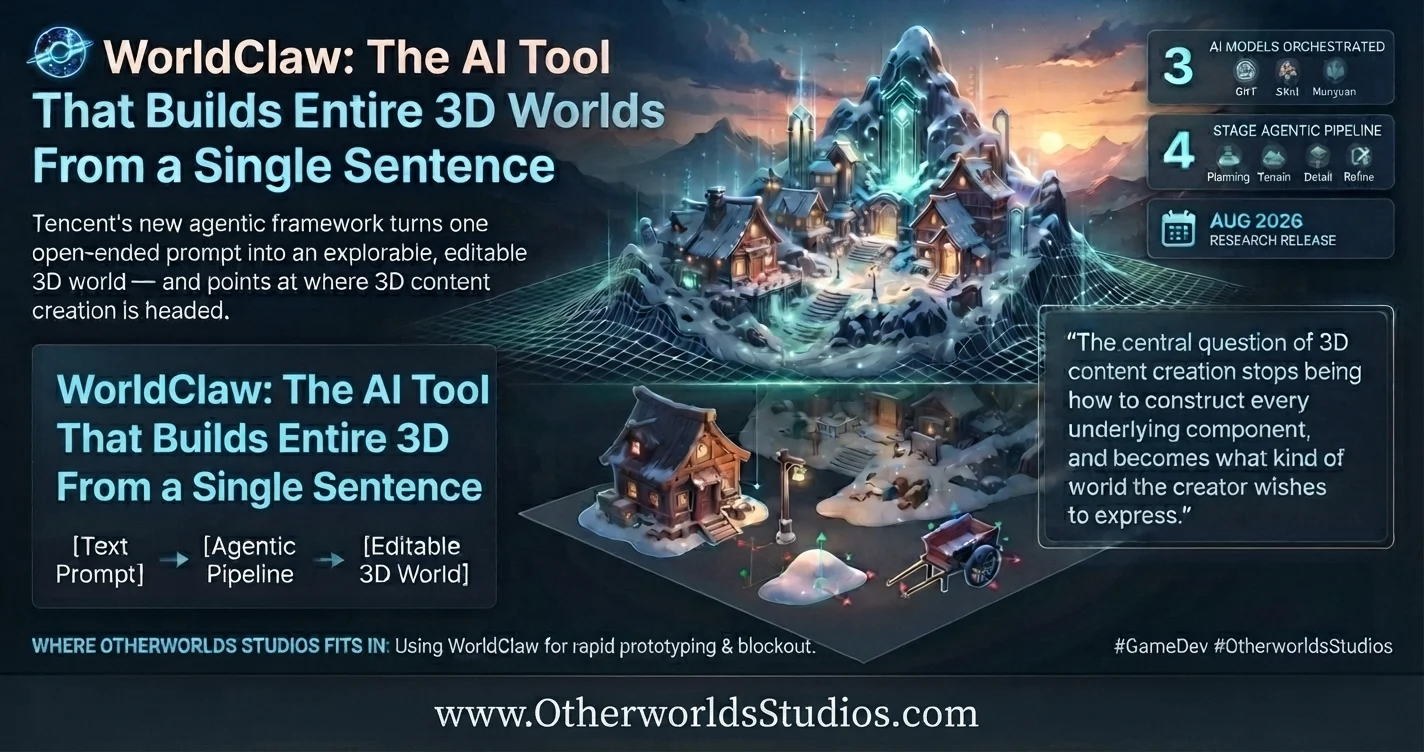
WorldClaw: The AI Tool That Builds Entire 3D Worlds From a Single Sentence.
Tencent's new agentic framework turns one open-ended prompt into an explorable, editable 3D world — and points at where 3D content creation is headed.
3: AI MODELS ORCHESTRATED
4: STAGE AGENTIC PIPELINE
AUG 2026: RESEARCH RELEASE
Type “a snowbound mountain village at dusk” into a text box, and a few minutes later you're looking at a fully realized 3D environment — terrain, houses, lamp posts, carts, snowdrifts — every object its own separate, editable asset. That's the pitch behind WorldClaw, a new research project out of Tencent's Hunyuan3D team, and it's one of the most ambitious AI 3D generation systems to surface this year.
For studios that live at the intersection of traditional 3D pipelines and the fast-moving world of generative AI, WorldClaw is worth a close look — not because it's ready to replace Unity or Unreal Engine tomorrow, but because of what it signals about where world-building is headed.
1: WHAT WORLDCLAW ACTUALLY DOES:
Most AI scene-generation tools produce something that looks impressive in a screenshot but falls apart the moment you try to actually use it — a single fused mesh, a point cloud you can't edit, a splat you can look at but not touch. WorldClaw takes a different approach. It's built to output a usable 3D scene: individually editable objects, sitting on a coherent terrain, ready to hand off to a rendering or animation pipeline.
It does this through what the team calls an “agentic, coarse-to-fine” process:
● Planning agents read the text prompt and translate it into a structured specification — regions, terrain, assets, materials, and how everything relates spatially.
● Global terrain generation builds a coherent geography from semantic layout maps and region-aware height fields, so the world holds together instead of feeling like disconnected patches.
● Detail-demanding regions get rendered as 2D imagery, populated with objects by an image-editing model, then converted into individual 3D assets and placed back on the terrain.
● Render-guided refinement agents clean up the result — fixing how objects sit against the terrain and where contact points don't quite line up.
Under the hood, WorldClaw leans on serious existing firepower: GPT Image 2 for the 2D imagery, Meta's Segment Anything Model 3 (SAM 3) to isolate individual objects, and Hunyuan3D's own image-to-3D pipeline to turn those objects into real, editable meshes. It's less a single model and more an orchestration of several — an agent directing a small army of specialists.
2: WHY THIS IS DIFFERENT FROM SPLATS AND NERFS:
A lot of the recent buzz in AI-generated 3D has centered on Gaussian splats and NeRFs — techniques that produce visually rich scenes but are notoriously difficult to edit, animate, or drop into a game engine. They're great for capturing a moment; they're painful to actually work with downstream.
WorldClaw sidesteps that problem by outputting explicit, separable geometry from the start. If a scene has a house, a tree, and a cart, those are three distinct meshes an artist could pull out, swap, re-skin, or animate independently — the same way they'd expect to work in Unity or Unreal. That's the detail that matters most for production pipelines, and it's what separates a genuinely useful tool from a tech demo.
“The central question of 3D content creation stops being how to construct every underlying component, and becomes what kind of world the creator wishes to express.”
3: WHERE IT STILL FALLS SHORT:
To be clear, WorldClaw is a research paper, not a shipped product — the team behind it is explicit that this is early-stage work. The current results are best described as a coherent starting point rather than a finished asset. Object-level fidelity, material realism, and fine spatial control still lag well behind what a skilled artist can produce by hand in Unreal Engine 5 or Unity's HDRP.
The paper's own authors note that a major direction for future work is moving toward code-native 3D modeling with explicit part hierarchies and tighter integration with production game engines — which tells you plainly that today's version isn't there yet.
Support our research
Independent analysis fueled by you.
There's also the open question of control. Traditional 3D tools give an artist granular, deterministic control over every vertex and every light. Agentic systems like WorldClaw trade some of that control for speed and scale — you get a full explorable world out of one sentence, but getting exactly the world you pictured still takes iteration, and sometimes a lot of it.
4: WHAT IT MEANS FOR STUDIOS WATCHING THIS SPACE:
The honest takeaway isn't “AI is replacing 3D artists” — it's that the role of the artist is shifting toward direction and curation. As agentic tools take over more of the grunt work of asset search, base terrain construction, and rough material assignment, the interesting creative question stops being how to build every piece of a world and starts becoming what world to build in the first place.
That's a meaningful shift, and it's worth tracking closely if you're building anything in games, film previsualization, or virtual production.
WHERE OTHERWORLDS STUDIOS FITS IN:
Tools like WorldClaw won't replace a full production pipeline anytime soon — but as blockout, previsualization, and rapid-prototyping tools, they can meaningfully compress the distance between an idea and something you can actually walk through.
Otherworlds Studios tracks emerging generative-3D tools like this closely and helps teams figure out where they genuinely speed up production, and where hands-on craft still wins. Reach out to talk through how AI-assisted 3D workflows could fit into your studio's pipeline.